
Why Concrete Sinks
and How to Fix It
Driveways, sidewalks, patios, and garage floors all settle for the same three reasons. Here is what is actually happening under the slab and a no-nonsense comparison of the three ways to fix it.
Every Concrete Slab Sits on Soil — and Soil Moves
A four-inch residential concrete slab weighs roughly 50 pounds per square foot. That weight rests entirely on the soil beneath it, and the moment that soil shifts, compresses, or washes away, the slab follows it down. It does not matter how well the concrete was mixed or how thick the pour was. If the ground underneath changes, the slab will settle.
This is why concrete settling is the single most common flatwork problem in the Midwest. Kansas City's heavy expansive clay and Des Moines' glacial till both hold water in wet seasons and shrink dramatically during drought. Add freeze-thaw cycling, poor original grading, and years of gutter runoff, and you have a recipe for uneven slabs across driveways, patios, pool decks, sidewalks, and garage floors.
The good news: settled concrete is almost always fixable without tearing it out. The key is understanding why the slab dropped so you can choose a repair that addresses the root cause — not just the symptom. Below, we break down the three mechanisms that cause concrete to sink and then compare the three repair methods side by side.
Three Causes of Concrete Settling
The cross-section below shows a typical residential slab and the three most common failure points underneath it.
Soil Washout
Water is the number-one enemy of the soil beneath your slab. Every time it rains, water runs off your roof, flows down the driveway grade, and pools against the edges of concrete slabs where there is a natural gap between the slab edge and the adjacent soil. Over months and years, that water finds its way underneath, carrying fine soil particles with it and leaving behind an expanding void.
Disconnected or missing downspout extensions are the most common accelerator. A single downspout during a heavy Midwest thunderstorm can deposit 50 gallons of water per hour at the base of your foundation — and if that water has nowhere to go but under your driveway or patio slab, the erosion happens fast. Poor grading compounds the problem. When the yard slopes toward the slab rather than away from it, every rain event drives more water beneath the concrete.
You will usually notice washout-related settling at slab edges first. The perimeter drops while the center stays relatively level, creating a concave dip. Driveways that meet the garage floor are especially vulnerable: the joint between the driveway and the garage apron opens up, creating a visible lip and a gap where more water enters. Left alone, the settling accelerates because the void itself channels future water flow.
The fix starts with controlling the water — extend your downspouts, correct the grading, and install drainage if needed. Then lift the slab back to level with polyjacking to fill the void permanently with closed-cell foam that water cannot wash out again.
Poor Compaction
When a home is built, the builder excavates a large hole for the foundation, installs the footings and walls, and then backfills the space around the foundation with the excavated soil. That backfill is supposed to be compacted in thin lifts — six to eight inches at a time — with a plate compactor or jumping jack. In practice, many builders dump the soil back in one thick layer and drive over it a few times with a skid steer. The result passes a visual inspection but leaves the fill at 75 to 85 percent compaction instead of the 95 percent minimum required for stable slab support.
This poorly compacted backfill can take five to fifteen years to finish settling under its own weight and the weight of the concrete above it. That is why many homeowners do not see driveway or patio problems until years after their home was built. The settling is slow, progressive, and hard to notice until a two-inch lip appears at a joint line.
Organic material in the fill makes it worse. Topsoil, tree roots, construction debris, and scrap wood decompose underground, leaving pockets of air where solid soil used to be. Older homes built before modern compaction standards are particularly susceptible, but even new-construction homes in fast-growing suburbs suffer when builders cut corners under schedule pressure.
Because the root cause is density — the soil simply was never packed tightly enough — the best repair injects material that expands to fill every remaining gap without adding significant weight. Polyurethane foam weighs about four pounds per cubic foot compared to 100+ pounds for the soil it displaces, so it lifts the slab without causing further compaction stress.
Tree Root Damage
Mature trees within 15 to 20 feet of a concrete slab can cause settling through two mechanisms. First, living roots physically compress and displace the soil as they grow, creating channels that compact the soil unevenly beneath the slab. Second — and more destructively — when roots die or are cut during construction, the decaying wood leaves behind tubular voids that collapse under the weight of the slab above.
Large deciduous trees also compete aggressively for moisture. During hot summer months, a single mature oak can draw 100+ gallons of water per day from the surrounding soil, causing the clay to shrink and pull away from the underside of the slab. When the rains return, the clay re-expands but rarely recovers to its original elevation. This seasonal ratcheting effect — shrink, swell, net loss — compounds year after year.
Tree-root settling tends to appear as localized dips rather than uniform slab drop. You might see one section of a sidewalk panel sink two inches while the panels on either side stay level. If you notice a settled slab near a large tree, check the soil moisture with a screwdriver — if it pushes in easily more than six inches on one side and hits resistance on the other, the root zone is pulling moisture unevenly.
Three Ways to Fix Settled Concrete
Once a slab has settled, you have three options. Each has a place — the right choice depends on the condition of the concrete, the depth of the void, and your budget.
Tear-Out & Replace
The slab is demolished with a jackhammer or saw, hauled away, the subgrade is re-compacted, new forms are set, and fresh concrete is poured. You cannot use the surface for at least seven days while it cures. This is the most expensive and most disruptive option but is necessary when the concrete itself is severely cracked, crumbling, or spalling beyond repair.
Mudjacking
Two-inch holes are drilled through the slab and a heavy cement-sand-water slurry is pumped underneath to fill the void and lift the concrete. The holes are patched with mortar. Mudjacking works but has trade-offs: the slurry weighs 100+ pounds per cubic foot (adding load to already weak soil), the larger holes are visible, and the material can erode or settle again if water continues to flow through the subgrade.
Polyjacking
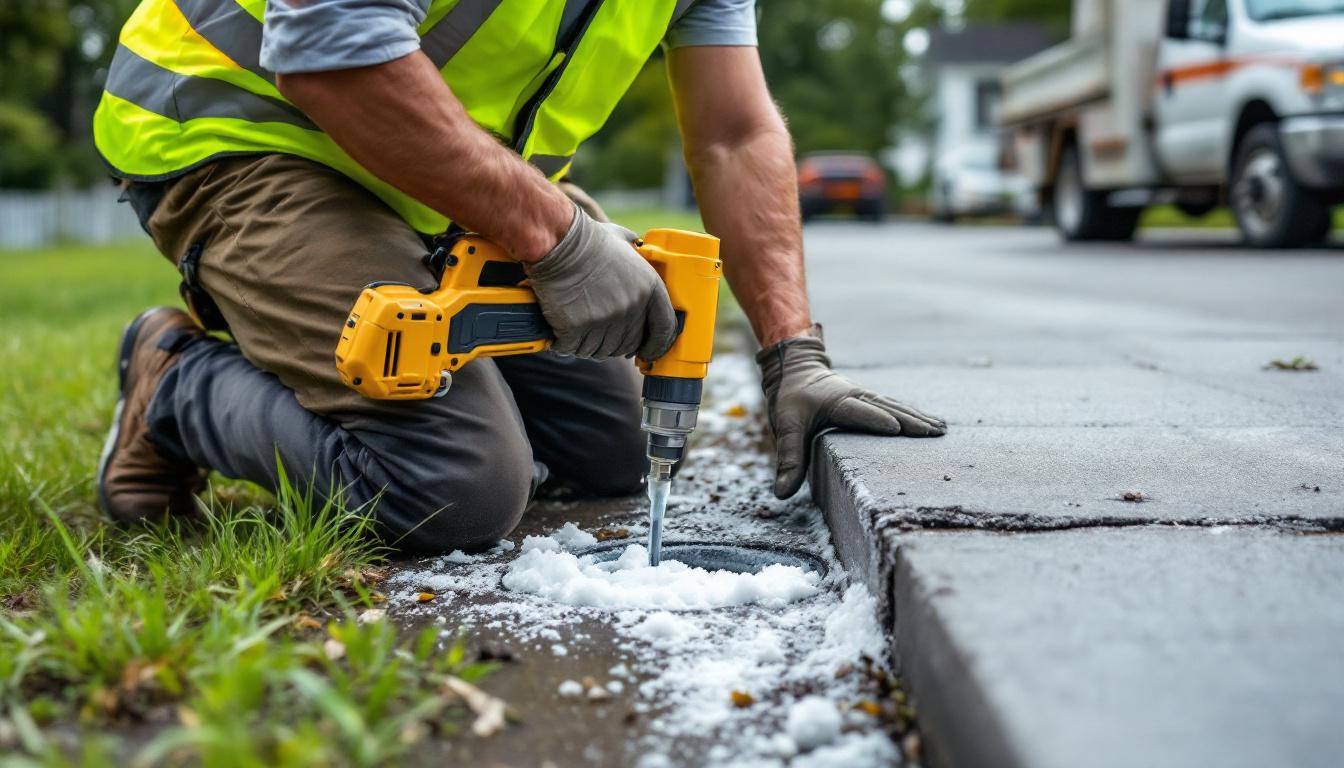
Penny-sized holes (5/8 inch) are drilled through the slab. A two-part polyurethane resin is injected through a port. The foam expands to 15 to 20 times its liquid volume in about 15 seconds, filling every void and lifting the slab with precise, controllable force. The foam weighs only 4 pounds per cubic foot, does not absorb water, and will not wash out or re-settle. You can walk and drive on the slab within 15 minutes.
Learn About Our Polyjacking Service →When to Replace vs. When to Lift
Not every settled slab is a candidate for lifting. The decision comes down to the condition of the concrete itself, not the condition of the soil underneath it. If the slab is structurally intact — no crumbling edges, no severe spalling, no pieces broken into three or more sections — it can almost certainly be lifted with polyjacking regardless of how far it has settled.
A slab that has sunk four inches but is still in one piece is a better candidate for lifting than a slab that has only sunk one inch but is broken into six fragments. Lifting foam needs a stable plate to push against. When the concrete is shattered, the foam expands into the cracks instead of underneath the slab, and you end up with an expensive mess rather than a level surface.
Here is a simple rule of thumb: if the concrete is ugly but solid, lift it. If the concrete is disintegrating, replace it. Surface blemishes, minor hairline cracks, and cosmetic imperfections are not reasons to replace. Structural failure is. When in doubt, schedule a free inspection — an experienced technician can tell the difference in five minutes.
How Polyjacking Works
The Cost of Waiting: Foundation Damage Over Time
Concrete Settling FAQ
Settlement creates an uneven surface — one section of the slab sits lower than the adjacent section, producing a visible lip or trip hazard at the joint. A surface crack without any height difference is cosmetic and usually caused by shrinkage during curing. If you can place a straightedge across the joint and see daylight under one side, the slab has settled.
Yes. When a driveway or patio slab settles toward the house, it redirects rainwater against the foundation wall instead of away from it. Over time this creates hydrostatic pressure, saturates the soil along the footing, and can cause basement wall bowing, floor cracks, and water intrusion. Fixing the settled slab early prevents a much more expensive foundation repair later.
Polyurethane foam is a closed-cell material that does not absorb water, erode, or compress under load. In most residential applications, a polyjacking repair lasts the remaining life of the slab — 20 to 30 years or more. Mudjacking uses a cement-and-soil slurry that can wash out or settle again if the underlying drainage issue is not corrected, and repairs typically last 5 to 10 years.
Polyjacking typically costs 50 to 70 percent less than a full tear-out and replacement. A 200-square-foot driveway panel might cost $1,000 to $1,600 to lift with foam, versus $2,400 to $4,800 to demo, haul, re-grade, form, pour, and cure a new slab. Polyjacking also avoids the 7-day cure time — you can walk and drive on the slab the same day.
Polyurethane foam can be injected in any season as long as the ground is not frozen solid at the surface. In the Kansas City and Des Moines metros, the prime window runs from March through November. Some contractors pause during deep winter freezes, but mild winter days above 35 degrees Fahrenheit are still workable. Spring is the most popular season because homeowners notice settlement after winter freeze-thaw cycles.
Noticed Your Concrete Settling? We Assess It for Free.
A quick on-site inspection tells you exactly what caused the settling and whether a same-day polyjacking repair can save you thousands over a full replacement.