
Interior vs. Exterior Waterproofing:
Which Do You Need?
Two fundamentally different approaches to the same problem. One works from inside your basement. The other works from outside your foundation wall. Here is how to know which one your home actually needs.
These Are Not Interchangeable
When a homeowner searches for "basement waterproofing," they usually land on one of two solutions: interior systems or exterior systems. What most articles fail to explain is that these are not two versions of the same thing. They solve the same problem — water in your basement — but they do it from opposite sides of the foundation wall, at very different price points, with very different tradeoffs.
Interior waterproofing manages water after it enters the wall cavity. Exterior waterproofing prevents water from reaching the wall in the first place. Neither approach is universally "better." The right choice depends on your home's age, the source of the water, your budget, and whether you are already doing excavation work for another reason.
This guide breaks down exactly how each method works, what it costs, how long installation takes, and — most importantly — which situations call for which approach. If you are getting quotes and trying to make sense of conflicting recommendations, this is the page that will cut through the noise.
Two Systems, One Goal
A cross-section view showing how interior and exterior waterproofing protect your basement from different sides of the foundation wall.
Interior Waterproofing
Interior waterproofing is the most common solution for residential basements that are actively taking on water. The system works by managing water that has already penetrated through or under the foundation wall — capturing it before it spreads across your basement floor and removing it through a sump pump.
How It Works
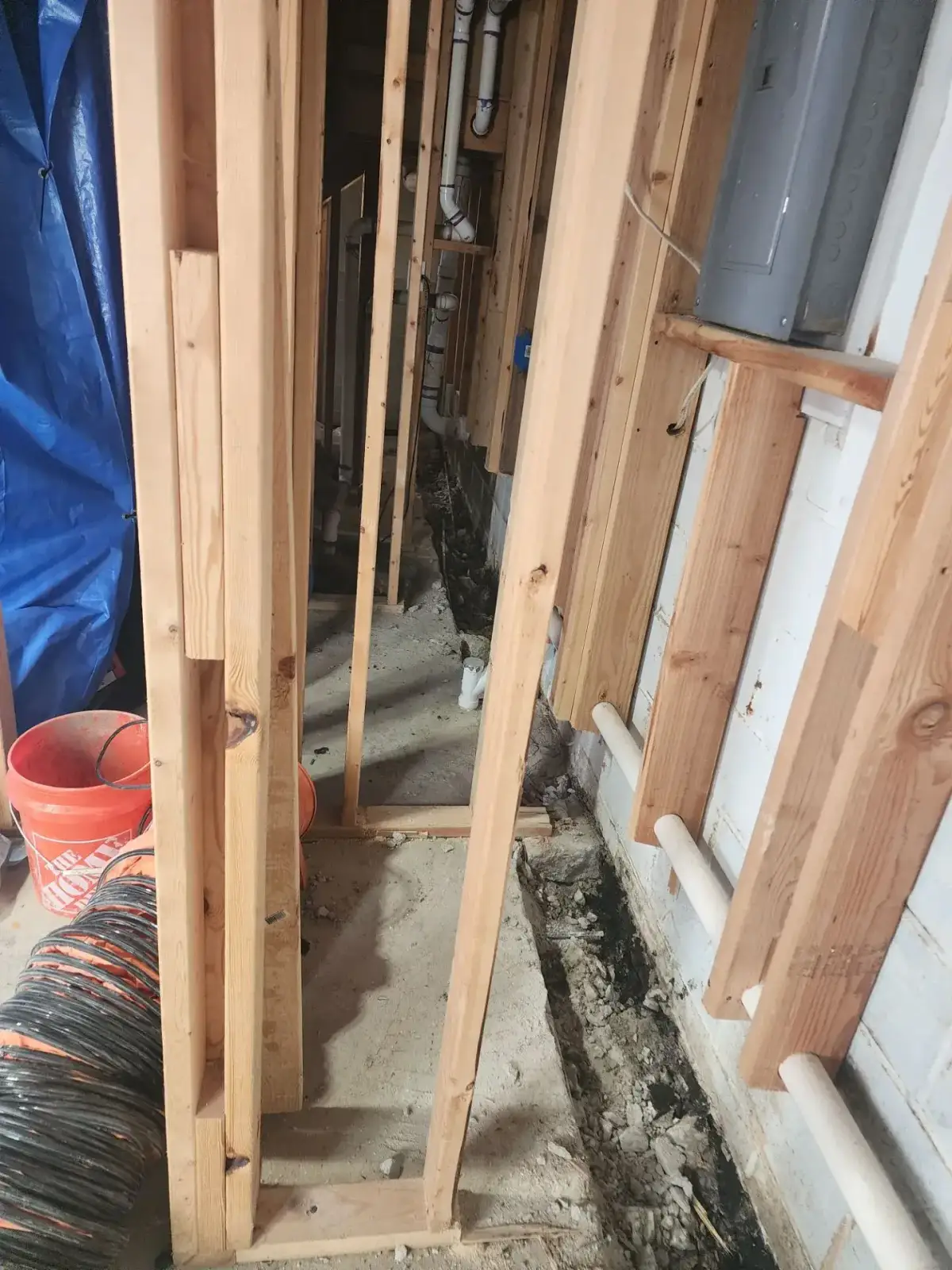
The process starts with cutting a narrow trench along the perimeter of the basement floor, right where it meets the foundation wall. A perforated drain tile (a four-inch pipe with holes) is laid inside that trench, surrounded by gravel. This channel intercepts water as it seeps in at the wall-floor joint — the most common entry point in any basement. All the drain tile runs slope toward a sump pit, which is a basin set into the floor at the lowest point. A sump pump inside the basin activates automatically when water reaches a certain level and ejects it through a discharge pipe that carries it away from the foundation. On the walls themselves, a vapor barrier (a dimpled plastic sheet) is often installed to direct condensation and minor wall seepage down into the drain tile channel rather than allowing it to dampen the wall surface.
What It Costs
For a typical basement — roughly 1,000 to 1,500 square feet of floor space — a full-perimeter interior drain tile system with sump pump runs between $3,000 and $8,000. Partial-perimeter installs (targeting just the problem wall) come in lower. Adding a battery backup sump pump adds $500 to $800 but is strongly recommended for storm-prone areas like Kansas City and Des Moines.
Timeline
Most interior waterproofing jobs take 2 to 3 days. Larger basements or those with extensive existing water damage may take a day longer. All work happens inside the home, so weather is not a factor.
Advantages
- No excavation — your yard, landscaping, and driveway stay untouched
- Can be installed year-round regardless of weather or temperature
- Most cost-effective solution for active basement leaking
- Proven long-term track record (systems last the life of the home)
- Fastest installation timeline
Limitations
- Does not prevent water from reaching the exterior of the foundation wall
- Relies on a sump pump — requires electricity (backup recommended)
- Does not address exterior drainage or grading issues
Exterior Waterproofing
Exterior waterproofing stops water before it ever touches the interior of your foundation wall. It is the more invasive and expensive of the two approaches, but it provides a layer of protection that interior systems cannot — direct shielding of the foundation wall from soil moisture, hydrostatic pressure, and groundwater.
How It Works
The process begins with excavation. The soil surrounding the foundation is dug out all the way down to the footing — typically 7 to 9 feet deep, depending on the depth of the basement. Once the exterior wall is fully exposed, it is cleaned, inspected for cracks or damage, and repaired if needed. Then a waterproof membrane is applied directly to the exterior surface of the wall. Modern membranes are either spray-applied rubberized asphalt or peel-and-stick sheets that create a continuous, seamless barrier. At the base of the wall, an exterior drain tile (similar to the interior version) is installed alongside the footing, wrapped in filter fabric to prevent sediment clogging, and surrounded by gravel. The trench is then backfilled — typically with a mix of gravel and native soil — and the grade is restored to direct surface water away from the foundation.
What It Costs
Exterior waterproofing for a full foundation typically ranges from $8,000 to $15,000 or more, depending on the depth of excavation, length of the wall, soil conditions, and whether landscaping, walkways, or porches need to be removed and rebuilt. The excavation itself accounts for a large portion of the cost.
Timeline
Expect 3 to 7 days for a full exterior waterproofing project. This can extend further if the excavation encounters utilities, retaining walls, or other obstacles. The work is weather-dependent — rain delays excavation, and frozen ground in winter makes it impractical.
Advantages
- Stops water before it reaches the foundation wall — the most thorough protection
- Protects the wall from moisture degradation, freeze-thaw damage, and hydrostatic pressure
- Exterior drain tile handles groundwater at the source
- Ideal when combined with foundation repair that already requires excavation
Limitations
- Requires full excavation around the foundation (major disruption to landscaping)
- Significantly more expensive than interior systems
- Cannot be done in winter or during sustained rain
- Porches, decks, and driveways adjacent to the wall may need removal
Comparison Table
A direct comparison of the two methods across the factors that matter most to homeowners.
| Factor | Interior | Exterior |
|---|---|---|
| How it works | Drain tile along footing captures water inside the basement and routes it to a sump pump | Waterproof membrane on exterior wall blocks water; drain tile at footing diverts groundwater |
| Typical cost | $3,000 - $8,000 | $8,000 - $15,000+ |
| Timeline | 2 - 3 days | 3 - 7 days |
| Excavation required? | No — all work inside the basement | Yes — full depth around the foundation |
| Works in winter? | Yes — weather independent | No — frozen ground prevents excavation |
| Best for | Active basement leaking, budget-conscious homeowners, homes with established landscaping | New construction, structural water intrusion, foundation wall deterioration, combined with foundation repair |
| Limitations | Does not stop water from reaching the wall; relies on sump pump | Major yard disruption; higher cost; weather-dependent scheduling |
When Interior Is the Right Choice
For the majority of homeowners dealing with a wet basement, interior waterproofing is the right call. It is the standard solution that waterproofing contractors install most often, and for good reason: it directly addresses the most common cause of basement water — seepage at the wall-floor joint during heavy rain or snowmelt.
Interior is especially the right choice if you have active water on the floor or walls during rain events, if your budget is a primary concern, if you have finished landscaping, patios, or walkways that you do not want destroyed, or if you need the work done during winter months when excavation is not possible. In the Kansas City and Des Moines metros, where clay-heavy soils drive hydrostatic pressure against foundation walls during wet seasons, interior drain tile systems are the single most installed waterproofing solution by a wide margin. Most homes do not need anything more.
If your foundation walls are structurally sound and the issue is simply water getting in, interior waterproofing will solve the problem for a fraction of the cost of going exterior.
When Exterior Is the Right Choice
Exterior waterproofing makes the most sense in a handful of specific scenarios. If you are building a new home, exterior membrane application is standard because the walls are already exposed before backfill — there is no excavation cost. If you are already excavating for foundation repair (wall straightening, pier installation, crack repair from the outside), adding exterior waterproofing while the wall is exposed is cost-efficient and logical.
Exterior is also the right approach when the foundation wall itself is deteriorating from decades of moisture exposure — particularly old limestone or block walls that are spalling, flaking, or losing morite between courses. In these cases, the goal is not just to stop water from entering the basement but to protect the wall material from further degradation. If you have serious exterior drainage issues — poor grading, missing downspout extensions, or a high water table — exterior drain tile combined with grading corrections may be the only permanent solution.
For most existing homes without structural wall issues, exterior waterproofing alone is overkill. But when paired with foundation repair or new construction, it is the gold standard.
Can You Do Both?
Yes — and in severe cases, a belt-and-suspenders approach is exactly what we recommend. A home with a deteriorating foundation wall, high water table, and active basement flooding may benefit from exterior membrane plus interior drain tile with a sump pump. The exterior membrane protects the wall and reduces the volume of water reaching the interior. The interior system catches whatever gets through and pumps it out.
That said, most homes only need one or the other. During our free inspection, we assess the actual source of the water, the condition of the foundation wall, and the grading and drainage around the home. We then recommend the approach that solves the problem without over-engineering the solution. If interior waterproofing will fix it, we will not push you toward a $15,000 excavation. That is not how we operate.
For a deeper look at all waterproofing methods and how they fit together, visit our waterproofing services page.
5 Most Common Basement Water Entry Points
Frequently Asked Questions
Yes — for most residential basements, an interior drain tile system with a sump pump is the permanent fix. It does not stop water from reaching the exterior of the wall, but it captures and removes water before it enters the living space. Thousands of homes in Kansas City and Des Moines rely on interior systems installed 10, 15, or 20+ years ago that still function perfectly. The key is proper installation along the full perimeter and a reliable sump pump with battery backup.
It depends on the situation. If you are building a new home or already excavating for foundation repair, exterior waterproofing is absolutely worth adding because the wall is already exposed. For an existing home with active basement leaking and no structural issues, interior waterproofing delivers the same dry basement at a fraction of the cost and disruption. Exterior makes the most financial sense when it can piggyback on other excavation work.
A properly installed interior drain tile system lasts the lifetime of the home. The drain tile itself is nearly indestructible — the component that needs occasional maintenance is the sump pump, which typically lasts 7 to 10 years before replacement. Exterior waterproof membranes are rated for 25 to 50+ years depending on the product used, and the exterior drain tile has a similar lifespan since it is protected by gravel backfill and filter fabric.
Yes. The sump pump is the engine of an interior waterproofing system. Drain tile channels water to a sump pit, and the pump ejects it away from the foundation. We recommend a primary pump plus a battery backup so the system keeps working during power outages — which is exactly when heavy storms are most likely to overwhelm your basement. Without a pump, the drain tile has nowhere to send the water.
Interior waterproofing can be installed year-round because all work happens inside the basement. Temperature and weather have no effect on the installation. Exterior waterproofing is weather-dependent — frozen ground cannot be excavated safely, and membrane adhesion is compromised in extreme cold. In Kansas City and Des Moines, exterior work is best scheduled between April and November.
Not Sure Which Approach Your Home Needs?
Our inspection will tell you. We look at the water source, the wall condition, and the drainage around your home — then give you a straight recommendation with a written estimate. No obligation.